
 Getting started
How the game works
Provinces, land, resources, people, happiness, gold and net worth, the ideas every other chapter builds on.
Your empire and its provinces
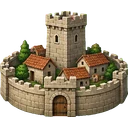
Your empire is your capital plus every province you add. Each province is a full town on the map, with its own buildings, queues, people and troops. A few buildings stand only in your capital: the university, market, bank, watchtower, tavern and hospital.
A new province must touch land you already hold, and you found one at a time: settle an empty spot, annex an independent province, or take one with your army. The Dominion research sets how many provinces you can hold. Your provinces are never taken from you. See New provinces and vassal lands.
Land
Every province stands on one kind of land, and the land changes what it makes:
| Land | What it changes |
|---|---|
| Plains | Nothing |
| Fertile | Farms feed 10% more people |
| Forest | The lumbermill makes 25% more wood |
| Hills | The iron mine and stone quarry make 25% more |
| Mountains | The iron mine and stone quarry make 25% more, and farms feed 10% fewer people |
| Peaks | No province stands on them |
How much of the map each land covers is on The map.
Resources
| Resource | What it pays for |
|---|---|
 Wood | Most of every price: buildings, troops and research |
 Iron | Weapons and armor for your troops, and part of every building |
 Stone | Buildings, the castle most of all |
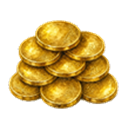 Gold | Upkeep, research, feasts and the alliance. Buildings cost no gold |
Wood, iron and stone belong to the province that made them, and the Depot Station moves them between your provinces. Gold belongs to your whole empire. See The depot.
To compare resources, the game counts them in gold-eq: a resource's worth counted in gold.
The warehouse
Each province's warehouse sets how much wood, iron and stone it can hold: 300,000 of each at level 1, and more at every level. A full store stops filling, so raise the warehouse before your mills outgrow it. See The warehouse.
The warehouse also keeps a share of what it holds safe from a siege: 5% at level 1, rising to 15% at its top level. Gold has no limit and is never safe. Gold is what a siege comes for.
People
Houses set how many people a province can hold, and farms how many it can feed. People move in every hour until the houses are full. Once there are more people than the farms can feed, growth slows down.
Your people do everything. Workers run the mills and pay the tax, and every soldier you train is drawn from your people. See Troops and training. Disbanding troops sends them home and gives back 50% of what they cost.
Happiness
Each province has its own happiness, up to 120. Happiness above 90 speeds up growth, and happiness below it slows growth down. Below 50, 2% of the people leave every hour.
Your tax moves happiness every day. Feasts, the temple and the castle raise it. A pillage or a fallen wall lowers it in that province. The Happiness window shows what moves it each day. See Population and happiness.
Gold and upkeep
Gold comes from the tax your workers pay, from selling on the market, from the bank's deposits, from loot, from vassal lands' tribute, from players who submitted to you, and from blessings. See Market, bank and depot.
Soldiers in your field army cost gold every hour. On the march they cost 20% more. Troops in the garrison or in the reserve cost nothing. See Upkeep.
Net worth
Your net worth is the size of your empire in points. It starts at 0. Buildings, research and troops you add raise it, and so does every province and vassal land.
The rankings list players by net worth. See Rankings.
Your beginner protection ends once your net worth passes 15,000 points. See Your first day.